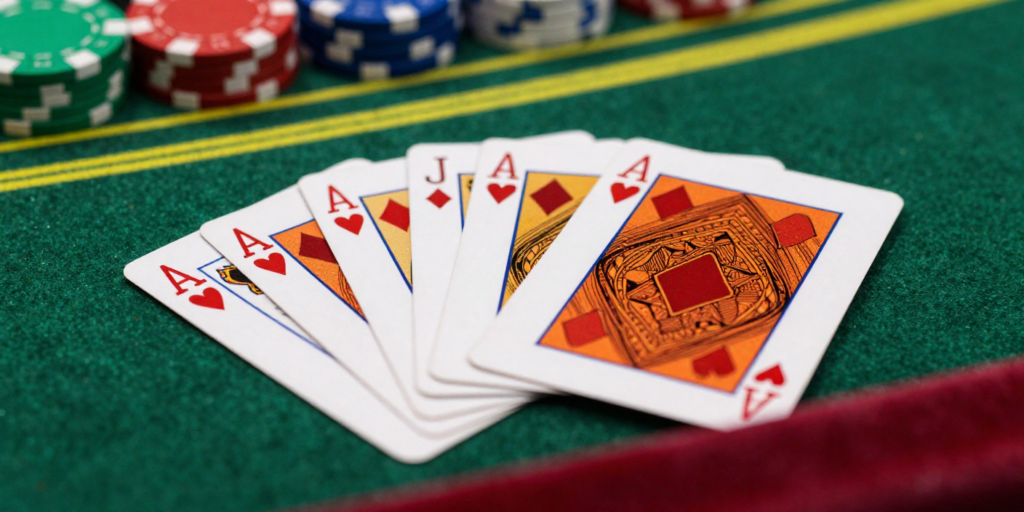

Three-card baccarat keeps the core idea of baccarat—comparing point totals between two hands—but changes the texture of the game by using three cards instead of two. The result is a variant with different hand distributions, side bets, and house edges, so treating it as “just regular baccarat with an extra card” is a quick route to misunderstanding your real risk. Understanding how scoring, payouts, and optional bets work in this version is essential if you want to approach it with clear expectations rather than assumptions.
What 3-Card Baccarat Actually Is
3-Card Baccarat is a casino table game where both the player side and the dealer (or banker) side receive three cards from a single standard 52-card deck, and the higher point total wins. Suits do not matter, and card values follow baccarat-style scoring: tens and face cards are worth 0, aces are worth 1, and all other cards are worth their pip value. The hand total is the sum of the three card values, usually considered modulo 10, so only the last digit of the total counts, just as in traditional baccarat.
Unlike classic baccarat, there is no drawing phase governed by third-card rules because each side starts and ends with three cards immediately. That change means the game is mechanically simpler on a per-hand basis—no complex hit/stand logic—but the probability structure under the surface is different because more card combinations are possible. From the player’s perspective, this affects how often certain totals occur and how valuable specific side bets really are compared to how exciting they look.
How Scoring Works With Three Cards
The scoring system in 3-Card Baccarat is designed to feel familiar if you already know basic baccarat, but you need to account for the extra card when thinking about likely totals. Each card’s value is added together, and if the sum is two digits, the tens digit is dropped so that only a number from 0 to 9 remains. That means a hand like 7–8–9, which sums to 24, is treated as 4, while 10s and face cards primarily act as zero-value fillers that change combinations without increasing the total directly.
Because there are three cards instead of two, mid-range totals between 3 and 7 become more common, while extreme values depend more on specific combinations of low or high cards. Some rule sets also pay attention to the number of face cards in a hand, not for the basic outcome but for side bets such as “Three Faces,” which target a hand of three face cards for a special payout. These additions sit on top of the basic 0–9 scoring, so new players need to distinguish between what determines the main win and what triggers separate, higher-risk wagers.
Main Bets, Payouts, and House Edge
The core wager in 3-Card Baccarat is typically a bet on whether the player hand or the dealer hand will show the higher total, with a push if the totals tie. In many implementations, including documented online and land-based versions, a winning player-hand bet is paid at slightly less than even money—often 97:100 or similar—which reflects a built-in commission that creates the house edge. If the dealer hand is higher, the main wager loses; if totals are equal, the stake is usually returned.
Mathematical analyses of the game show that, depending on the exact pay table and any commission structure, the house advantage on the main player-hand bet tends to fall in the low single digits. For example, one widely cited analysis of 3-Card Baccarat with a single deck and specific pay rules indicates a player bet house edge around 3.1% without commission, and around 1.4–2.4% in versions where the commission is structured differently or applied selectively. The key practical takeaway is that, while the main bet is far safer than the flashier options, it is generally less favorable than the best Banker/Player bets in classic baccarat, which sit near the 1% range.
Common Side Bets and Why They’re Risky
3-Card Baccarat often features several side bets that pay off when rare hand patterns occur, especially on the dealer’s side. Typical examples include wagers on the exact point total of the dealer hand, tie outcomes with specific odds, and high-paying combinations of face cards. These bets are designed to look attractive because they offer payout multiples far above the main wager, but their underlying probabilities usually make them statistically expensive in the long run.
A notorious example is the “Three Faces” or “Three Face Cards” bet, which wins only if the relevant hand (often the dealer’s) consists of three face cards and loses otherwise. Analytical work on this bet in a single-deck 3-Card Baccarat context shows that, at a 16:1 payout, the house edge can be on the order of 83%, meaning the casino keeps most of the theoretical value over time. When the payout is raised to around 96:1, the edge drops to a more typical but still substantial figure near 3–4%. This contrast illustrates why side bets need to be evaluated by math rather than by eye-catching payoffs.
Comparing 3-Card Baccarat to Standard Baccarat
To understand 3-Card Baccarat in context, it helps to compare it directly with traditional baccarat, focusing on mechanics and expected returns rather than surface similarities. While both games involve comparing hand totals and using 0–9 scoring, their structures diverge in how many cards are drawn and how the house edge is constructed. That divergence affects the role of skill, the pace of the game, and the types of risks players tend to take.
| Feature | Standard Baccarat | 3-Card Baccarat |
| Cards per hand | Typically two cards, with optional third card based on fixed drawing rules. | Always three cards dealt to both player and dealer; no further drawing. |
| Main bet options | Banker, Player, Tie, sometimes with additional side bets. | Usually a bet on player hand beating dealer hand, with optional tie and point-total bets. |
| Typical house edge on core bets | Around 1.06% on Banker, 1.24% on Player, roughly 14% on Tie (varies by rules). | Low single digits on main hand bet (around 1.4–3.1% depending on pay table), much higher on some side bets. |
| Role of side bets | Optional, often with high house edges but not central to the game. | More prominent, including Three Faces and dealer total bets, with widely varying edges. |
This comparison shows that 3-Card Baccarat is generally less favorable than the best standard baccarat bets from a purely mathematical standpoint, but it offers a different mix of volatility and novelty. Players who enjoy pattern-hunting or chasing rare combinations might find the extra side bets engaging, while those focused on minimizing house edge may prefer to stick to the main wager or choose standard Banker/Player bets in classic baccarat instead. The right choice depends on whether you prioritize entertainment variety or long-term expected value.
Basic Step-by-Step Flow of a 3-Card Baccarat Round
From a player’s perspective, each round of 3-Card Baccarat follows a straightforward sequence. The simplicity is part of its appeal, especially for those already familiar with comparing hands in other table games. However, understanding each step and its implications helps you avoid confusion about when decisions are made and which outcomes trigger specific payouts.
Before looking at the steps, note that most versions of the game are largely non-strategic in the sense that you make your betting choices before any cards appear, and there are no decisions about drawing or holding once the deal starts. Your main decisions revolve around what to bet on and how much to stake, especially in relation to your bankroll and risk tolerance. Treating the game as “decide once, observe the outcome” keeps your focus on stake sizing and bet selection rather than on in-hand tactics that don’t exist in this format.
Typical round sequence
- Place your main bet on the player hand (and optionally any side bets such as tie, dealer total, or Three Faces).
- The dealer deals three cards to the player side and three to the dealer side from a single shuffled deck.
- Both hands are scored by summing card values and taking the last digit of the total, yielding a result from 0 to 9.
- The higher total wins; if totals match, the outcome is a tie and main stakes are usually returned.
- Winning main bets are paid at the specified odds (often slightly less than 1:1), and side bets are settled according to whether their specific conditions were met.
Seeing the game as this fixed sequence underscores why bankroll and bet-choice discipline matter more than “strategy” in the usual sense: once the cards are out, the outcome is entirely determined by the rules. That structure also means that the house edge on each bet will play out over time regardless of hunches or betting patterns, which should encourage you to question whether any high-edge side wagers deserve a place in your regular play.
Practical Guidelines for New 3-Card Baccarat Players
For beginners approaching 3-Card Baccarat from standard baccarat or other table games, a few practical principles can prevent common misunderstandings. First, treat the main player-hand bet as your default and be cautious about side wagers until you have a clear sense of their true cost; their advertised payouts often mask a much higher house advantage. Second, size your bets with the understanding that the house edge is generally higher than on the best standard baccarat bets, which means you should expect your bankroll to erode faster over equal volumes of play.
Third, if you are playing 3-Card Baccarat within a broader gambling environment, consider how it fits into your overall session goals. Because the game’s mechanics are straightforward and each round resolves quickly, it can be tempting to use it as a “break” game between more complex options, but the underlying edge does not relax just because the rules are simple. Aligning your time, stake sizes, and choice of side bets with your broader bankroll plan helps you avoid treating this variant as lower risk just because it feels easy to follow.
If you access the game through a multi-product sports betting service such as ufa747 login, it becomes especially important to track how much of your total gambling budget is being allocated to higher-edge table variants versus core, lower-edge options. When everything—from sports markets to multiple baccarat styles—is available under one account, the risk is that you mentally separate them while your bankroll does not. A more structured approach is to decide in advance what percentage of your total stake you are willing to dedicate to novelty games like 3-Card Baccarat and to cap both your main and side-bet exposure within that slice so that an entertaining diversion does not quietly become a major drain on your overall results.
Where 3-Card Baccarat Can Mislead or Fail Players
3-Card Baccarat can be misleading when players mistake its simplicity for fairness or assume that all bets on the felt are roughly equal in value. The reality is that the spread between the best and worst wagers at the table can be enormous, with some side bets holding house edges dozens of times higher than the main hand wager. Without looking at the actual probabilities, it is easy to overuse these bets, especially during hot streaks or when chasing an eye-catching combination.
The game can also fail players who bring standard baccarat expectations without adjusting for the differences in house edge and volatility. For example, someone accustomed to low-1% edge Banker bets might assume that the core wager here behaves similarly over time, only to find that their bankroll decays faster than expected. In the absence of realistic expectations about the math, small structural differences—three cards rather than two, altered pay schedules—can accumulate into surprisingly large gaps in long-term performance.
In digital settings where multiple card games are one click apart, this misunderstanding can be magnified. If you move back and forth between standard baccarat, 3-Card Baccarat, and other quick table games on a casino online platform without tracking which ones are consuming most of your losing sessions, you may misattribute your results to “bad luck” rather than to systematically choosing higher-edge variants. Keeping records of where your bankroll is actually going helps you see whether 3-Card Baccarat is delivering the entertainment you want at a cost you find acceptable, or whether it is quietly pulling more than its share of value out of your play.
Summary
3-Card Baccarat takes the familiar baccarat idea of comparing hand totals and reshapes it by dealing three cards to each side, adjusting payouts, and introducing distinctive side bets. The main hand wager is straightforward and moderately priced in house-edge terms, but several popular optional bets carry very high built-in advantages for the casino. Approaching the game with a clear understanding of its scoring, pay tables, and role within your broader bankroll plan allows you to treat it as a deliberate choice—one that offers novelty and simplicity—rather than as a low-risk alternative that it is not mathematically designed to be.