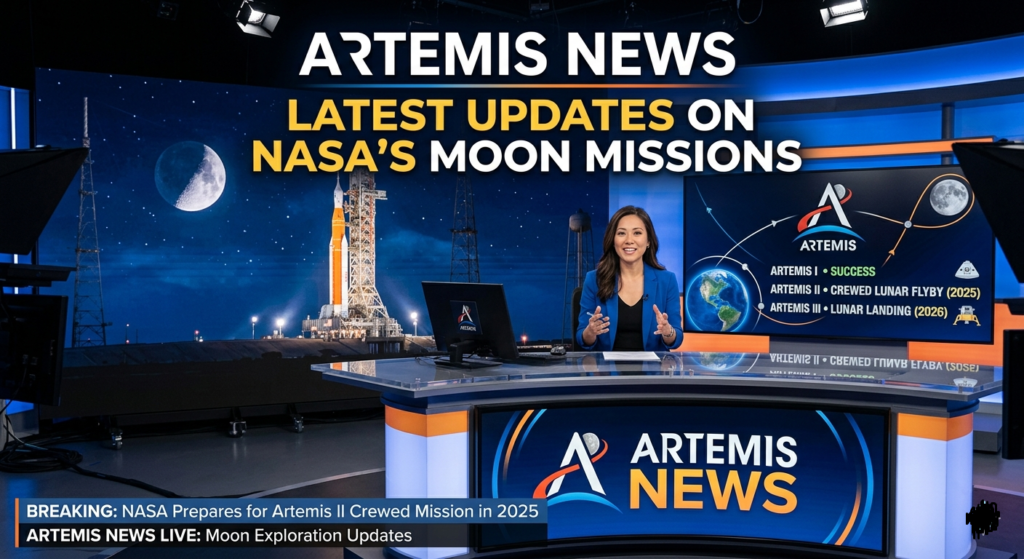

The world is once again looking toward the Moon, and much of that excitement revolves around the latest artemis news. NASA’s Artemis program represents one of the most ambitious space exploration initiatives of the 21st century. Designed to return humans to the lunar surface and establish a long-term presence there, Artemis is laying the foundation for future missions to Mars and beyond.
Unlike the Apollo missions of the 1960s and 1970s, Artemis is focused on sustainable exploration. NASA aims not only to land astronauts on the Moon but also to create the infrastructure needed for continued scientific research and deep-space exploration. Recently it has highlighted advancements in spacecraft technology, international partnerships, astronaut training, and mission planning.
What Is the Artemis Program?
The Artemis program is NASA’s flagship lunar exploration initiative. Named after Artemis, the twin sister of Apollo in Greek mythology, the program symbolizes the next chapter of human exploration beyond Earth. The primary goal of Artemis is to return astronauts to the Moon while creating a sustainable lunar presence that can support future deep-space missions.
The Origins of Artemis
Following the success of the Apollo missions, human exploration of the Moon largely came to a halt. Although robotic missions continued to study the lunar surface, no astronauts returned after Apollo 17 in 1972. Decades later, advancements in technology and renewed interest in deep-space exploration led NASA to develop Artemis.
Main Objectives of Artemis
NASA has outlined several major goals for Artemis:
- Return humans to the Moon
- Land the first woman on the lunar surface
- Land the first person of color on the Moon
- Establish a sustainable lunar presence
- Conduct advanced scientific research
- Develop technologies for future Mars missions
- Strengthen international partnerships in space exploration
Why the Artemis Program Matters
The Moon serves as an ideal testing ground for technologies and systems that will eventually support missions to Mars. By learning how humans can live and work on another celestial body, NASA hopes to reduce risks associated with future deep-space exploration.
Artemis News at a Glance: Quick Facts Table
| Category | Details |
| Program Name | Artemis |
| Managed By | NASA |
| Main Objective | Sustainable human exploration of the Moon |
| First Mission | Artemis I |
| Launch Vehicle | Space Launch System (SLS) |
| Crew Spacecraft | Orion |
| Future Destination | Moon and Mars |
| Key International Partners | Multiple space agencies worldwide |
| Long-Term Goal | Establish lunar infrastructure and prepare for Mars |
| Current Focus | Human lunar landing and lunar sustainability |
Latest Artemis News and Mission Updates
Recently it has focused on mission preparations, technological milestones, and updates to NASA’s exploration timeline. The Artemis program continues to move forward despite the challenges associated with developing cutting-edge space technologies.
Mission Preparation Progress
NASA engineers continue to conduct extensive testing on critical mission systems.
These include:
- Spacecraft safety systems
- Communication technologies
- Navigation equipment
- Life-support systems
- Lunar landing technologies
Astronaut Training Developments
One major topic in recent artemis news involves astronaut training programs.
Future Artemis astronauts are undergoing rigorous preparation that includes:
- Lunar surface simulations
- Emergency response exercises
- Spacecraft operations training
- Geological field studies
- Advanced robotics training
Advancements in Lunar Technology
Modern lunar exploration requires far more sophisticated technology than was available during the Apollo era.
Current developments include:
- Advanced spacesuits
- Autonomous robotic systems
- Precision landing technologies
- Enhanced communication networks
- Sustainable power solutions
Infrastructure Development
NASA is working on infrastructure that will support long-term lunar operations.
Key projects include:
- Lunar Gateway station
- Surface habitats
- Scientific laboratories
- Resource utilization systems
Understanding the Artemis Mission Timeline
The artemis news consists of multiple missions, each designed to achieve specific objectives and build toward future exploration goals.
Artemis I: The First Step
Artemis I was an uncrewed test mission that marked a major milestone for NASA.
The mission successfully demonstrated:
- Orion spacecraft performance
- Deep-space navigation capabilities
- Re-entry procedures
- Communication systems
- Space Launch System effectiveness
Artemis II: Returning Humans to Lunar Space
Artemis II will be the first crewed mission in the Artemis program.
Its primary objectives include:
- Testing life-support systems
- Evaluating spacecraft performance with astronauts onboard
- Conducting a lunar flyby
- Verifying mission readiness for future landings
Artemis III: The Planned Lunar Landing
Among all mission phases, Artemis III generates some of the most exciting artemis news.
The mission is expected to:
- Land astronauts on the Moon
- Explore new lunar regions
- Conduct scientific experiments
- Demonstrate advanced lunar technologies
Future Artemis Missions
Beyond Artemis III, NASA envisions a series of missions focused on expanding human activity on the Moon.
These future missions may include:
- Long-duration lunar stays
- Construction of lunar habitats
- Expanded scientific research
- Resource extraction experiments
- Advanced robotics deployment
Spacecraft and Technologies Behind Artemis
One reason artemis news remains so popular is the groundbreaking technology being developed for the program. Several key systems make Artemis possible.
Space Launch System
The Space Launch System is NASA’s most powerful rocket.
Its capabilities include:
- Carrying heavy payloads
- Supporting deep-space missions
- Transporting astronauts beyond Earth orbit
- Enabling lunar and future Mars exploration
Orion Spacecraft
The Orion spacecraft is designed to transport astronauts safely through deep space.
Key features include:
- Advanced life-support systems
- Radiation protection
- Emergency safety technologies
- Deep-space navigation capabilities
Lunar Gateway
Gateway is a planned space station that will orbit the Moon.
Its purposes include:
- Supporting astronaut operations
- Serving as a scientific platform
- Facilitating lunar landings
- Acting as a staging point for future missions
Human Landing Systems
Landing astronauts safely on the Moon requires highly specialized vehicles.
NASA and its partners are developing systems capable of:
- Precision lunar landings
- Surface mobility
- Cargo transportation
- Sustainable operations
Advanced Spacesuits
Future Artemis news astronauts will use next-generation spacesuits designed for lunar exploration.
Benefits include:
- Improved mobility
- Enhanced safety
- Better environmental protection
- Greater operational flexibility
International Partners Supporting Artemis
One of the most unique aspects of the Artemis program is its global collaboration. Unlike many historical space initiatives, Artemis involves extensive international participation.
Global Cooperation in Space Exploration
Numerous countries and organizations contribute expertise, technology, and resources to Artemis.
This cooperation helps:
- Reduce costs
- Increase scientific capabilities
- Accelerate technological innovation
- Promote peaceful exploration
The Artemis Accords
The Artemis Accords establish guidelines for responsible space exploration.
These agreements focus on:
- Transparency
- Scientific cooperation
- Resource utilization
- Safety standards
- Peaceful activities in space
Commercial Industry Participation
Private companies also play an important role in Artemis.
Industry partners contribute:
- Spacecraft technologies
- Landing systems
- Robotics
- Infrastructure development
- Mission support services
The Future of International Lunar Exploration
As more countries participate in lunar exploration, Artemis is becoming a truly global endeavor.
Future collaborations may involve:
- Shared lunar research facilities
- Joint scientific missions
- International astronaut participation
- Cooperative infrastructure projects
Why Artemis News Matters for Space Exploration
The growing interest reflects more than just excitement about returning to the Moon. The Artemis program represents a major step forward in humanity’s long-term exploration of space. For decades, scientists have viewed the Moon as an ideal location for testing technologies that could eventually support missions to Mars and beyond.
Advancing Scientific Knowledge
One of the most important reasons Artemis matters is its scientific value.
Astronauts and robotic systems will study:
- Lunar geology
- Water ice deposits
- Surface composition
- Radiation exposure
- Space weather effects
Preparing for Mars Exploration
NASA views the Moon as a proving ground for future Mars missions. Before humans can safely travel to Mars, researchers need to understand how astronauts can:
- Live in harsh environments
- Manage limited resources
- Operate far from Earth
- Maintain long-term health during deep-space missions
Driving Technological Innovation
Space exploration often leads to technological breakthroughs that benefit life on Earth. Innovations developed through Artemis may improve:
- Communication systems
- Robotics
- Medical technology
- Energy solutions
- Materials engineering
Inspiring Future Generations
Space programs inspire students to pursue careers in science, technology, engineering, and mathematics. The excitement generated by artemis news helps encourage young people to become future scientists, engineers, and explorers.
Major Challenges Facing Artemis Missions
Although the Artemis program is ambitious and exciting, it also faces significant challenges. Successfully returning humans to the Moon requires overcoming technical, financial, and environmental obstacles.
Technical Complexity
Modern lunar missions are far more advanced than earlier space programs. Engineers must ensure:
- Spacecraft reliability
- Astronaut safety
- Mission accuracy
- Communication effectiveness
- Equipment durability
Budget and Funding Considerations
Large-scale space programs require substantial investment.
Costs include:
- Rocket development
- Spacecraft construction
- Research and testing
- Infrastructure development
- Mission operations
Schedule Delays
Complex projects frequently encounter delays.
Common reasons include:
- Additional safety testing
- Engineering modifications
- Supply chain challenges
- Weather considerations
- Technical reviews
Lunar Environmental Challenges
The Moon presents a harsh environment for both humans and equipment.
Challenges include:
- Extreme temperatures
- High radiation levels
- Abrasive lunar dust
- Long periods of darkness
- Limited resources
Long-Term Sustainability
NASA’s goal extends beyond a single lunar landing. Creating a lasting presence on the Moon requires:
- Reliable energy systems
- Resource management
- Habitat construction
- Transportation networks
- Continuous logistical support
Artemis vs Apollo Missions
Many people compare Artemis to the historic Apollo program. While both involve lunar exploration, they differ significantly in objectives, technology, and long-term vision.
Similarities Between Artemis and Apollo
Both programs share several key goals:
- Human exploration of the Moon
- Scientific research
- Technological advancement
- National and international interest
- Expansion of human knowledge
Key Differences in Technology
Modern technology gives artemis news capabilities that Apollo never had. Examples include:
- Advanced computers
- Improved navigation systems
- Modern communications
- Enhanced safety features
- Sophisticated robotics
Mission Objectives
Apollo’s primary objective was to land humans on the Moon and return them safely to Earth.
Artemis has broader goals:
- Sustainable lunar exploration
- Long-term infrastructure development
- International cooperation
- Preparation for Mars missions
International Participation
Apollo was largely a national effort.
Artemis involves:
- Multiple space agencies
- International agreements
- Commercial partnerships
- Global scientific collaboration
Legacy and Future Impact
Apollo proved that humans could reach the Moon. Artemis news to demonstrate that humans can live and work there for extended periods. In many ways, Artemis is building upon Apollo’s legacy while creating a new vision for future exploration. The future of Artemis extends far beyond the first lunar landing missions. NASA has ambitious plans that could reshape space exploration over the coming decades.
Expanded Lunar Exploration
Future missions may include:
- Longer lunar stays
- Expanded scientific operations
- Increased astronaut activity
- New exploration zones
Lunar Habitats
Researchers are studying ways to create habitats that support long-term human presence.
Potential features include:
- Living quarters
- Research laboratories
- Resource processing facilities
- Energy generation systems
Resource Utilization
Future missions may focus on using local resources.
Potential applications include:
- Producing water
- Generating oxygen
- Creating fuel
- Supporting agriculture
Gateway Expansion
The Lunar Gateway is expected to grow over time.
Future additions may include:
- New modules
- Research facilities
- International contributions
- Advanced communication systems
Mars Preparation
Perhaps the most exciting aspect of it is its connection to future Mars missions.
Everything learned through Artemis will help NASA prepare for:
- Deep-space travel
- Long-duration missions
- Human survival beyond Earth
- Interplanetary exploration
How to Stay Updated with Artemis News
With so many developments occurring, staying informed is easier than ever.
NASA regularly publishes:
- Mission announcements
- Launch schedules
- Research findings
- Program updates
- Educational resources
Official sources remain the most reliable option.
Watch Launch Events
Major Artemis milestones are often broadcast live.
These events provide:
- Real-time mission coverage
- Expert commentary
- Technical explanations
- Behind-the-scenes insights
Read Space Exploration Publications
Specialized space news websites frequently provide:
- Mission analysis
- Expert opinions
- Technical breakdowns
- Industry updates
Follow Scientific Research
Many Artemis-related discoveries appear in scientific journals and research publications. These resources offer deeper insight into the program’s scientific goals and achievements. As the program progresses, we will continue to provide exciting updates for anyone interested in the future of space exploration.
Final Thoughts
The Artemis program represents one of the most significant space exploration efforts in modern history. Through advanced technology, international cooperation, and ambitious scientific goals, NASA is preparing to return humans to the Moon while laying the groundwork for future missions to Mars.
As demonstrated throughout this guide, artemis news covers far more than rocket launches and astronaut training. It reflects humanity’s broader effort to explore, innovate, and expand beyond Earth.
FAQs About Artemis News
Q1: What is the Artemis program?
Ans: The Artemis program is NASA’s lunar exploration initiative designed to return humans to the Moon, establish a sustainable presence there, and prepare for future missions to Mars.
Q2: Why is Artemis important?
Ans: Artemis helps advance scientific research, develop new technologies, strengthen international cooperation, and prepare humanity for deeper space exploration.
Q3: What is the latest Artemis news about?
Ans: Recent Artemis developments focus on mission preparation, astronaut training, spacecraft testing, lunar landing technologies, and infrastructure planning.
Q4: What is Artemis III?
Ans: Artemis III is the mission expected to land astronauts on the Moon, marking the first human lunar landing of the Artemis era.
Q5: How is Artemis different from Apollo?
Ans: While Apollo focused on reaching the Moon, Artemis aims to establish a long-term human presence and support future Mars exploration.