
Starting a business is exciting, but one challenge stops many aspiring entrepreneurs before they even begin—finding the money to turn their idea into reality. If you’ve been searching for How to Get a Startup Business Loan With No Money, you’re not alone. Thousands of first-time founders have great ideas but little or no savings, no business revenue, and limited financial history.
The good news is that starting with no money doesn’t automatically disqualify you from receiving funding. Many lenders, government-backed programs, nonprofit organizations, and alternative financing options are designed to help entrepreneurs who have strong business ideas but lack startup capital. The key is understanding what lenders evaluate, preparing the right documents, and choosing the funding option that best fits your business goals. Entrepreneurs can use an AI logo generator to build a professional brand identity before approaching investors or lenders.
Can You Get a Startup Business Loan With No Money?
How to Get a Startup Business Loan With No Money, they often assume lenders only care about how much cash they currently have. In reality, lenders evaluate several factors together to determine whether you are likely to repay the loan successfully. These factors commonly include:
- Personal credit history
- Business plan quality
- Industry experience
- Projected cash flow
- Existing debt
- Business structure
- Collateral (if required)
- Ability to repay
What Does “No Money” Actually Mean?
It means they have no personal savings. Others may have enough money for daily living expenses but not enough to invest in a new business. Some may also have no collateral or no existing business revenue because they’re launching a company for the first time. Understanding your own financial position helps you identify the most suitable funding options. Common situations include:
- No personal savings
- No business income yet
- No collateral
- Limited credit history
- First-time business ownership
How Startup Business Loans Work
Startup loans differ from traditional business loans because new businesses don’t usually have years of financial statements or consistent revenue. Instead of relying only on business performance, lenders often examine the owner’s financial responsibility and the viability of the business idea. Most lenders review:
- Your credit score
- Your business plan
- Market demand
- Revenue projections
- Industry experience
- Existing financial obligations
Who Can Qualify for a Startup Business Loan?
Startup funding is available to many different types of entrepreneurs. You may qualify if you are:
- Launching your first business
- Expanding from freelance work into a registered company
- Starting an online business
- Opening a local service business
- Creating a home-based business
- Building a technology startup
- Purchasing an existing small business
Why Lenders Approve Some Startups and Reject Others
Many people believe loan approval depends only on income. In reality, lenders look at overall risk. Successful applicants usually demonstrate:
- A clear business model
- Realistic financial forecasts
- Strong personal financial habits
- Market research
- A practical repayment plan
- Industry knowledge
Rejected applications often suffer from:
- Poor planning
- Unrealistic revenue estimates
- Missing documents
- Weak credit history
- Borrowing more than necessary
Step-by-Step Guide to Getting a Startup Business Loan With No Money
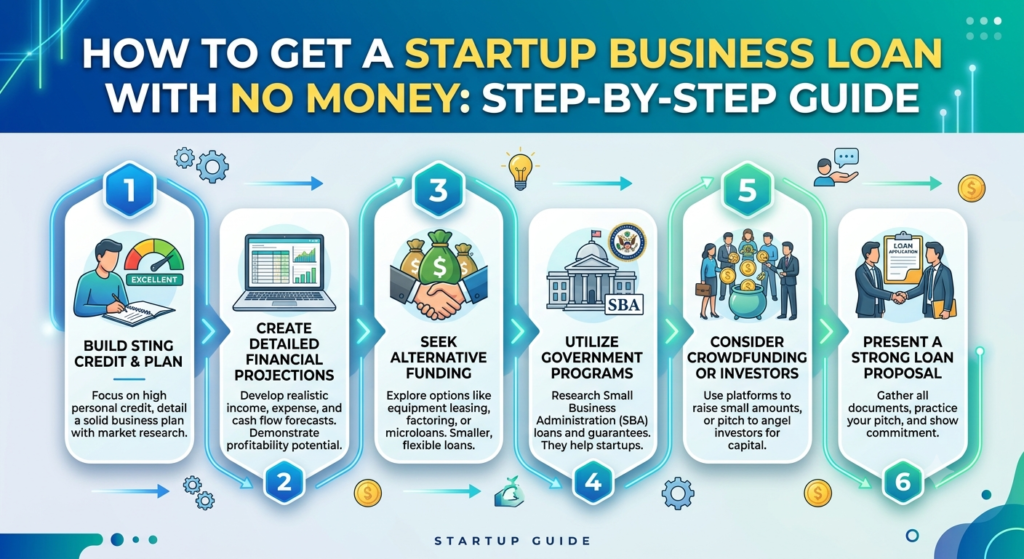
If you’re serious about learning How to Get a Startup Business Loan With No Money, follow these practical steps before submitting your first application.
Create a Strong Business Plan
Many entrepreneurs underestimate its importance, but lenders view it as evidence that you’ve carefully planned your business rather than acting on an impulse. Your business plan should answer questions such as:
- What problem does your business solve?
- Who are your customers?
- Why will customers choose your business?
- How will your business generate revenue?
- What expenses will you incur?
- How will you repay the loan?
These Sections in Your Business Plan
- Executive summary
- Business description
- Products or services
- Market analysis
- Competitor research
- Marketing strategy
- Operations plan
- Financial projections
- Funding request
Check and Improve Your Personal Credit Score
For startups without revenue, your personal credit score often becomes one of the biggest approval factors. Lenders use it to measure how responsibly you’ve managed debt in the past. Generally:
- Excellent credit increases approval chances.
- Good credit provides access to better interest rates.
- Fair credit may still qualify with stronger documentation.
- Poor credit often requires alternative funding options.
Ways to Improve Your Credit Score
- Pay bills on time.
- Reduce credit card balances.
- Avoid unnecessary loan applications.
- Correct errors on your credit report.
- Keep older credit accounts open when appropriate.
Register Your Business Properly
Even if you’re applying as a brand-new entrepreneur, formal registration shows lenders you’re serious about operating legally. Depending on your country, registration may include:
- Choosing a business structure
- Registering your business name
- Obtaining tax identification numbers
- Applying for required licenses
- Opening official government registrations
Choose the Right Business Structure
Common structures include:
- Sole Proprietorship
- Partnership
- Limited Liability Company (LLC)
- Corporation
Open a Business Bank Account
Lenders prefer applicants who keep business transactions separate because it demonstrates professionalism and makes financial tracking much easier. A business bank account can help you:
- Build business credibility
- Track expenses accurately
- Separate personal and business income
- Simplify bookkeeping
- Prepare financial statements
- Establish banking relationships
What You’ll Typically Need
Requirements vary by financial institution, but you’ll generally need:
- Business registration documents
- Tax identification number
- Government-issued identification
- Business address
- Ownership information
Determine Exactly How Much Funding You Need
One of the biggest mistakes new entrepreneurs make is asking for more money than they actually need. Lenders appreciate applicants who understand their startup costs and have a realistic financial plan. If you’re researching How to Get a Startup Business Loan With No Money, remember that borrowing responsibly can increase your approval chances and reduce your repayment burden.
Common Startup Costs
- Business registration fees
- Licenses and permits
- Equipment and machinery
- Office or retail space
- Inventory
- Website development
- Marketing and advertising
- Insurance
- Employee salaries
- Utility bills
- Software subscriptions
- Emergency operating fund
Example Startup Budget
| Expense Category | Estimated Cost |
| Business Registration | $300 |
| Equipment | $6,000 |
| Website & Software | $1,200 |
| Initial Marketing | $2,000 |
| Inventory | $8,000 |
| Emergency Reserve | $2,500 |
| Total Funding Needed | $20,000 |
Compare Different Startup Loan Options
Not every lender offers loans designed for startups. Comparing multiple funding options allows you to find the best combination of interest rates, repayment terms, and eligibility requirements.
SBA-Backed Loans
Government-backed loan programs are among the most trusted funding options for startups.
Benefits
- Lower interest rates
- Longer repayment periods
- Higher borrowing limits
- Flexible eligibility requirements
Best For
- Entrepreneurs with a solid business plan
- Businesses expecting long-term growth
Microloans
Microloans are smaller loans typically offered by nonprofit organizations and community lenders. Loan amounts are usually suitable for:
- Home businesses
- Freelancers
- Online stores
- Service businesses
- Local startups
Benefits
- Easier approval
- Lower borrowing amounts
- Entrepreneur support programs
- Training opportunities
Online Business Loans
Online lenders often process applications faster than traditional banks. Advantages include:
- Faster approval
- Online applications
- Flexible qualification standards
Business Line of Credit
Instead of receiving one large payment, a business line of credit allows you to borrow only what you need. This option works well for businesses with ongoing expenses such as:
- Inventory purchases
- Marketing campaigns
- Seasonal cash flow
- Unexpected costs
Equipment Financing
If most of your funding is needed for equipment, equipment financing may be an excellent choice. Examples include:
- Restaurant equipment
- Manufacturing machines
- Construction tools
- Medical equipment
- Computers and office technology
The equipment itself often serves as collateral.
Community Development Financial Institutions (CDFIs)
CDFIs focus on helping underserved entrepreneurs who may struggle to obtain traditional financing. These organizations often provide:
- Startup loans
- Financial education
- Business mentoring
- Flexible approval standards
Prepare All Required Loan Documents
Complete application demonstrates professionalism and helps lenders review your request more efficiently. Applicants who organize their paperwork before applying often experience fewer delays.
Essential Documents
Prepare copies of:
- Business plan
- Personal identification
- Tax returns (if applicable)
- Personal bank statements
- Business registration documents
- Business licenses
- Financial projections
- Profit and loss forecast
- Cash flow forecast
- Personal financial statement
- Loan purpose explanation
Apply to Multiple Lenders Strategically
Many entrepreneurs make the mistake of applying to only one lender. Every lender has different approval standards, risk tolerance, and funding priorities. Instead of relying on a single application:
- Research several lenders.
- Compare eligibility requirements.
- Compare interest rates.
- Compare repayment terms.
- Submit applications strategically.
Avoid submitting dozens of applications within a short period, as excessive credit inquiries may affect your credit profile depending on the scoring model used.
Best Startup Business Loan Options When You Have No Money
Choosing the right funding source is just as important as preparing a strong application. Below are some of the most practical options for entrepreneurs with limited startup capital.
SBA-Backed Startup Loans
Ideal for:
- New businesses
- Long-term growth
- Larger funding needs
Advantages:
- Competitive interest rates
- Longer repayment terms
- Government support
Potential drawback:
- More documentation required.
Microloans
Ideal for:
- Small startups
- Home-based businesses
- First-time entrepreneurs
Advantages:
- Easier qualification
- Smaller loan amounts
- Helpful business guidance
Online Lenders
Ideal for:
- Faster funding
- Digital businesses
- Urgent startup expenses
Advantages:
- Quick decisions
- Convenient online application
Drawback:
- Interest rates may be higher.
Business Line of Credit
Ideal for:
- Managing cash flow
- Seasonal businesses
- Unexpected expenses
Advantages:
- Borrow only when needed
- Flexible repayment
Equipment Financing
Ideal for businesses purchasing:
- Machinery
- Vehicles
- Medical equipment
- Restaurant equipment
Benefits include preserving working capital while acquiring essential equipment.
Community Lending Programs
Many nonprofit lenders support entrepreneurs who may not qualify at traditional banks. These programs frequently assist:
- Women entrepreneurs
- Minority-owned businesses
- Rural businesses
- Veteran-owned businesses
- Low-income communities
In addition to financing, many programs offer mentoring and business education.
Requirements for Getting a Startup Business Loan
What lenders look for before you apply can save time and improve your chances of approval. While every lender has different criteria, most evaluate the same core factors. How to Get a Startup Business Loan With No Money, meeting these requirements will make your application much stronger.
Personal Credit Score
For a startup with little or no business history, your personal credit score is often one of the most important factors. A higher credit score demonstrates that you’ve managed debt responsibly in the past. Although minimum requirements vary by lender, stronger credit generally leads to better interest rates and loan terms.
If your credit score isn’t ideal, don’t assume funding is impossible. Some nonprofit lenders, microloan providers, and government-backed programs are more flexible, especially when paired with a strong business plan.
How to Improve Your Credit Profile
- Pay all bills on time.
- Reduce outstanding credit card balances.
- Avoid unnecessary debt.
- Review your credit report for errors.
- Maintain older credit accounts when appropriate.
Relevant Industry Experience
Experience reduces lender risk. Even if you’ve never owned a business before, highlight relevant experience such as:
- Employment in the same industry
- Freelancing
- Professional certifications
- Specialized training
- Leadership roles
- Technical skills
For example, a chef opening a restaurant or a software developer launching a technology company can strengthen their application by demonstrating years of practical experience.
Financial Projections
Lenders understand that startups don’t have years of revenue history. Instead, they want realistic projections showing how your business expects to generate income. Include estimates for:
- Monthly revenue
- Operating expenses
- Net profit
- Cash flow
- Break-even point
How to Improve Your Chances of Loan Approval
Approval isn’t just about qualifying—it’s about presenting yourself as a low-risk borrower. Below are proven strategies that can significantly strengthen your application.
Build Business Credit Early
As soon as your business is established:
- Open a business bank account.
- Obtain a business credit card (if appropriate).
- Pay suppliers on time.
- Keep financial records organized.
Reduce Existing Debt
High personal debt increases your debt-to-income ratio, making lenders more cautious. Before applying:
- Pay down high-interest debt.
- Avoid financing unnecessary purchases.
- Keep credit utilization low.
Strengthen Your Business Plan
Many loan applications are rejected because the business plan lacks detail. Include:
- Customer research
- Competitor analysis
- Sales forecasts
- Marketing strategies
- Risk management plans
Consider a Co-Signer
If your credit history is limited, a qualified co-signer may improve approval chances. A co-signer with strong credit can reduce lender risk, though they also become legally responsible for repayment if you fail to meet your obligations. Only pursue this option after discussing the responsibilities thoroughly.
Demonstrate Market Demand
Lenders are more confident when there is evidence that customers want your product or service. Helpful evidence includes:
- Pre-orders
- Letters of intent
- Customer surveys
- Market research
- Signed contracts
- Existing client inquiries
Real-world demand supports your financial projections.
Maintain Organized Financial Records
Even before generating revenue, organized records show professionalism. Keep copies of:
- Business registration
- Licenses
- Receipts
- Bank statements
- Tax documents
- Contracts
Pros and Cons of Startup Business Loans
Every financing option has advantages and disadvantages.
Advantages
- Provides startup capital.
- Allows you to retain ownership.
- Builds business credit.
- Supports business growth.
- Helps purchase equipment and inventory.
- Enables marketing and expansion.
Disadvantages
- Requires regular repayments.
- Interest increases total borrowing cost.
- Approval is not guaranteed.
- Missed payments can damage credit.
- Some loans require collateral.
Startup Business Loan vs. Business Grant vs. Investor Funding
Choosing the right funding option depends on your business model, growth plans, and willingness to repay or share ownership.
| Feature | Startup Business Loan | Business Grant | Investor Funding |
| Repayment Required | Yes | No | No |
| Give Up Ownership | No | No | Yes |
| Approval Difficulty | Moderate | High | High |
| Funding Speed | Moderate | Slow | Moderate |
| Best For | Most startups | Specific industries and projects | High-growth startups |
| Long-Term Cost | Interest | None | Equity ownership |
Final Thoughts
Securing funding without personal savings may seem challenging, but it is far from impossible. As you’ve learned throughout this guide, success depends less on how much money you currently have and more on how well you prepare your application, present your business idea, and choose the right financing option.
Strong business plan, realistic financial projections, organized documentation, and responsible financial habits all contribute to a more convincing loan application. Whether you pursue a government-backed loan, microloan, nonprofit lender, business grant, crowdfunding campaign, or investor funding, taking the time to understand your options can make a significant difference.
FAQs
Q1: Can I get a startup business loan with no money down?
Ans: Yes. Some lenders and government-backed programs allow qualified entrepreneurs to obtain startup financing without making a down payment. Approval depends on factors such as your credit history, business plan, industry experience, projected cash flow, and overall ability to repay the loan.
Q2: Can I get a startup business loan with bad credit?
Ans: Yes, although your options may be more limited. Microloan providers, nonprofit organizations, community lenders, and certain online lenders often consider applications from borrowers with lower credit scores.
Q3: What credit score is recommended for a startup business loan?
Ans: There is no universal minimum credit score because every lender has different lending standards. Generally, a higher credit score increases your chances of approval and helps you qualify for better interest rates.
Q4: Do I need collateral to get a startup business loan?
Ans: Some startup loan programs are unsecured, meaning they don’t require collateral. Others may ask you to pledge assets such as equipment, vehicles, inventory, or property.
Q5: What documents are required when applying for a startup business loan?
Ans: Most lenders request:
- A detailed business plan
- Government-issued identification
- Business registration documents
- Tax information (if available)
- Personal and business bank statements
- Financial projections
- Funding request details
- Business licenses or permits, if applicable