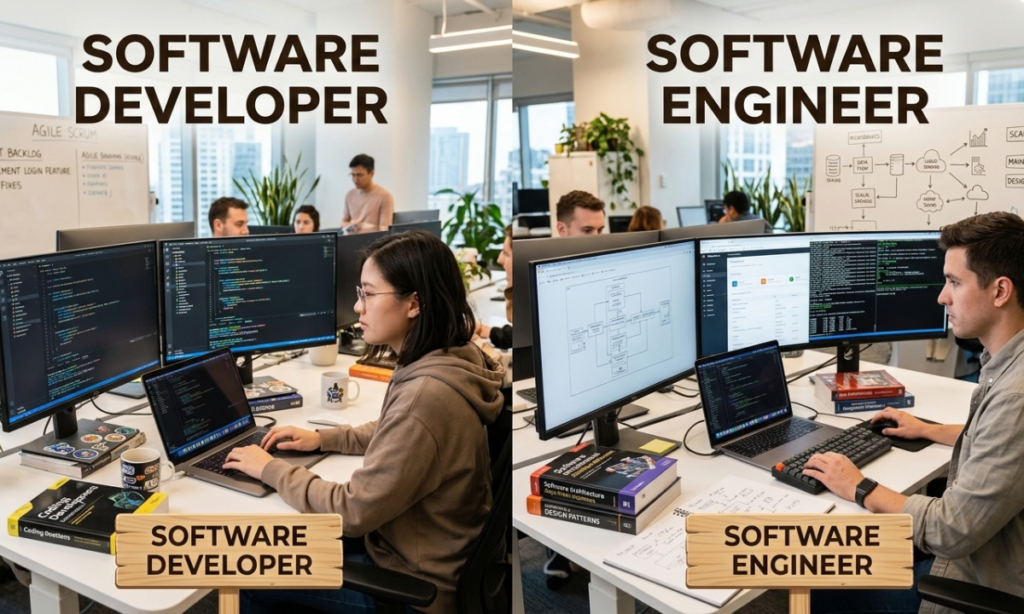

Choosing a career in technology can be exciting, but it can also create questions about which role to pursue. One common comparison is Software Developer vs Software Engineer. The two roles have many similarities because both can involve programming, testing, debugging, problem-solving, and building software.
The main difference is often related to the scope of responsibilities rather than completely different technical abilities. Software developers commonly focus on creating and maintaining applications, while software engineers may work more broadly with software systems, architecture, scalability, reliability, and technical design.
What Is a Software Developer?
A software developer is a professional who creates, modifies, tests, and maintains software applications or programs. Developers turn requirements and ideas into functional software that solves particular problems or provides useful services to users.
Their work can include planning features, writing code, testing applications, fixing errors, improving existing software, and documenting technical information. Developers may work on websites, mobile applications, business software, games, or other types of computer programs.
What Does a Software Developer Do?
The daily responsibilities of a software developer depend on the project and employer. A developer may analyze requirements, design software features, write code, test functionality, investigate bugs, and maintain existing applications. Developers also work with other professionals. They may communicate with designers, testers, product managers, project managers, database specialists, and other developers.
Common Types of Software Developers
Software development includes several areas of specialization. Common examples include:
- Web developers who build websites and web applications.
- Mobile developers who create applications for mobile platforms.
- Application developers who build software for specific business or user requirements.
- Systems software developers who work on software supporting computer systems.
- Full-stack developers who work with both front-end and back-end technologies.
The exact responsibilities depend on the organization, technology stack, and project requirements.
What Is a Software Engineer?
A software engineer applies engineering principles to the development and maintenance of software systems. Software engineering can cover requirements, design, architecture, programming, testing, maintenance, quality, reliability, and security. A software engineer may therefore consider not only whether a particular feature works, but also how different parts of a system interact and how the system can remain reliable and maintainable as it changes.
What Does a Software Engineer Do?
Software engineers can participate in software design, programming, testing, system architecture, maintenance, and technical planning. When working with complex systems, they may consider questions about performance, scalability, reliability, security, integration, and long-term maintenance.
Common Types of Software Engineers
Software engineering has many possible specialties. Examples include:
- Backend software engineers
- Frontend software engineers
- Full-stack software engineers
- Systems software engineers
- Embedded software engineers
- Cloud or infrastructure engineers
- Security-focused software engineers
The responsibilities of these positions vary according to the organization and technical environment.
Software Developer vs Software Engineer: Key Differences
The Software Developer vs Software Engineer comparison is easier when responsibilities and project scope are considered instead of assuming that the titles represent completely separate careers.
Difference in Roles and Responsibilities
Software developers often focus on creating, improving, testing, and maintaining applications. Software engineers may have additional responsibilities involving architecture, system design, technical planning, reliability, and scalability.
Difference in Problem-Solving Approaches
Developers commonly solve problems involving application features, bugs, user requirements, and software functionality. Software engineering may involve solving broader system-level problems. An engineer may consider how different components interact, how a system behaves under increased demand, and how technical decisions affect future maintenance.
Difference in Project Scope
A developer may be responsible for a specific application, feature, or component. An engineer may work across a larger technical system and participate in decisions involving architecture, integration, performance, reliability, or scalability. The actual scope depends on the employer. In many workplaces, developers and engineers can both contribute to large projects.
Difference in Tools and Technologies
There is no universal set of tools that belongs only to developers or only to engineers. Both professionals can use programming languages, databases, testing tools, version-control systems, APIs, cloud platforms, development environments, and collaboration tools. The difference is often in how these technologies are applied rather than which technologies are used.
What Skills Do Software Developers Need?
Programming and Coding Skills
Programming is a fundamental skill for software developers. Developers need to understand programming concepts and use languages and frameworks appropriate for their projects. The required technologies vary by specialization. A web developer, mobile developer, and systems developer may use very different technology stacks.
Testing and Debugging
Developers need to make sure that software behaves as expected. Testing helps identify defects, while debugging involves finding and correcting the causes of problems. A developer may test individual functions, application features, user interactions, and different conditions. Testing and debugging are important throughout development rather than only after coding is finished.
Database and Version Control Knowledge
Many software applications depend on databases, so developers may need to understand how information is stored, retrieved, updated, and managed. Version-control systems are also important for collaborative software projects. They allow developers to track code changes, work on different branches, and coordinate modifications with other team members. The specific tools depend on the position.
Communication and Teamwork
Software development is usually a collaborative activity. Developers may need to explain technical issues, discuss requirements, review code, document decisions, and communicate with non-technical colleagues. Good communication helps development teams coordinate their work and understand what a software product needs to accomplish.
What Skills Do Software Engineers Need?
Software Architecture and Design
Software engineers may need a strong understanding of architecture and software design, especially when working on complex systems. Architecture involves determining how major components are organized and how they communicate. A thoughtful design can make a system easier to maintain, test, modify, and expand over time.
System Design and Scalability
System design becomes important when software needs to support changing requirements or increasing demand. Engineers may consider performance, reliability, scalability, security, and communication between different services or components. For example, a system engineer may need to consider what happens when an application receives significantly more users than it originally supported.
Programming and Technical Skills
Software engineers still need strong programming knowledge. Engineering responsibilities do not remove the need to understand code. Depending on the position, engineers may work with programming languages, databases, APIs, cloud services, operating systems, testing frameworks, and other technical tools.
Problem-Solving and Analytical Thinking
Complex technical systems can produce complicated problems. Engineers need to break these problems into manageable parts, compare possible solutions, and consider technical trade-offs. Analytical thinking is useful in both software development and software engineering because professionals in both areas regularly investigate errors and make technical decisions.
Software Developer vs Software Engineer: Education and Qualifications
Degree and Educational Background
A degree in computer science, software engineering, information technology, mathematics, engineering, or a related subject can provide a strong foundation for a software career. University programs can introduce students to programming, algorithms, data structures, databases, computer systems, software design, and other technical concepts. However, educational requirements vary by employer and position.
Certifications and Online Learning
Certifications and online courses can help learners develop knowledge in programming, cloud technologies, databases, cybersecurity, software development tools, and other technical areas. They can be useful for expanding knowledge or demonstrating familiarity with a specific technology.
Importance of Practical Experience
Practical experience allows learners to apply theoretical knowledge to real problems. Students and beginners can gain experience through internships, personal projects, academic assignments, open-source contributions, or other development work. Building real applications can also help candidates demonstrate their skills during the hiring process.
Software Developer vs Software Engineer: Career Paths
Entry-Level Opportunities
Entry-level opportunities can include junior software developer, junior software engineer, application developer, web developer, or other specialized technical positions. Titles vary between organizations, so candidates should read the responsibilities and requirements carefully. Internships can also provide an opportunity to gain professional experience and learn how software teams operate.
Career Growth for Software Developers
Software developers can progress from junior positions to mid-level and senior roles. As their experience grows, developers may take responsibility for larger features, mentor junior developers, review code, specialize in particular technologies, or contribute to technical decisions. Some developers move toward technical leadership, project management, or management positions.
Career Growth for Software Engineers
Software engineers can also progress through junior, mid-level, and senior positions. Experienced engineers may take on larger architectural responsibilities, lead technical projects, mentor other engineers, or specialize in areas such as cloud infrastructure, distributed systems, security, or embedded software. Some eventually move into technical leadership or engineering management.
Specialization and Leadership Opportunities
Both career paths offer opportunities to specialize. Professionals can focus on web development, mobile development, cloud computing, cybersecurity, databases, artificial intelligence, embedded systems, distributed systems, or other technical fields. Leadership can involve managing people, leading projects, mentoring colleagues, or remaining on a technical career path as a senior individual contributor.
Software Developer vs Software Engineer: Salary Factors
Experience and Skill Level
Salary varies according to experience, technical skills, specialization, responsibilities, industry, and location. In the United States, software developers had a median annual wage of $135,980 in May 2025 according to the U.S. Bureau of Labor Statistics. Actual compensation varies significantly between individuals and employers. Therefore, there is no universal salary difference that applies to every Software Developer vs Software Engineer.
Location and Industry
Geographic location can have a significant effect on technology compensation. Industry also matters. Professionals working in software publishing, finance, manufacturing, technology services, and other sectors may encounter different compensation levels. For international comparisons, salary should also be considered alongside currency, taxes, living costs, and local employment conditions.
Company Size and Job Responsibilities
Company size can influence responsibilities and compensation. At a smaller company, one developer may work across many parts of an application. A larger organization may divide responsibilities among specialized teams. Roles involving architecture, leadership, large-scale systems, or specialized technical knowledge can have different compensation from entry-level development positions.
What Are the Similarities Between Software Developers and Software Engineers?
Shared Technical Skills
Both professionals can need programming, debugging, testing, software design, database knowledge, version control, and development tools. The exact skills depend on the particular position.
Working With Development Teams
Developers and engineers commonly work with other professionals, including testers, designers, product managers, project managers, security specialists, and database professionals. Communication and teamwork are therefore relevant to both career paths.
Building and Maintaining Software
Both developers and engineers can contribute to different stages of the software lifecycle. Their work may include planning, programming, testing, deployment, maintenance, troubleshooting, and improvements. This overlap explains why the distinction between the two job titles can sometimes be difficult to define.
Continuous Learning
Technology changes continuously. Software Developer vs Software Engineer need to learn new programming languages, frameworks, tools, platforms, and development practices throughout their careers. Continuous learning can help professionals adapt as technical requirements change.
Which Career Path Is Right for You?
Software development may suit people who enjoy writing code, creating applications, building features, debugging problems, and turning requirements into working software. If you enjoy seeing your code become a feature that users can directly interact with, a development-focused position may be appealing.
When Software Engineering May Suit You
Software engineering may appeal to people who enjoy larger technical problems involving architecture, system design, scalability, reliability, and long-term maintenance. If you are interested in understanding how multiple components work together and how systems can remain manageable as they grow, engineering responsibilities may be attractive.
Questions to Consider Before Choosing
Before choosing a career direction, consider several questions:
- Do you enjoy programming and writing code?
- Are you interested in software architecture?
- Do you prefer application features or larger system problems?
- Do you enjoy testing and debugging?
- Are scalability and system design interesting to you?
- Which technologies do you want to learn?
- Do you prefer technical specialization or leadership?
- What responsibilities are listed in the jobs you are considering?
These questions can help you compare actual career opportunities instead of relying only on job titles.
Final Thoughts
The Software Developer vs Software Engineer comparison is not about choosing between two completely separate careers. Both professionals can write code, solve technical problems, test software, collaborate with teams, and maintain applications and systems. The main difference often comes down to the scope and nature of their responsibilities.
Software developers commonly focus on building and improving software applications, while software engineers may work more broadly with system architecture, scalability, reliability, design, and long-term technical planning.
FAQs
1. What is the difference between a software developer and a software engineer?
A Software Developer vs Software Engineer often focuses on building and maintaining applications, while a software engineer may handle broader system design and architecture. However, the responsibilities can overlap, and companies may use these titles differently.
2. Is software engineering harder than software development?
Neither career is automatically harder because both require technical knowledge, programming, and problem-solving skills. The difficulty usually depends on the project, technology, responsibilities, and individual experience.
3. Do software developers and software engineers need the same skills?
Both roles commonly require programming, debugging, testing, communication, teamwork, and continuous learning. Software engineering positions may place additional emphasis on architecture, scalability, and system design.
4. Which career has better opportunities, software developer or software engineer?
Both paths can provide opportunities for specialization, senior technical roles, leadership, and management. Career opportunities depend on skills, experience, industry, location, and the specific employer.
5. Can a software developer become a software engineer?
Yes, Software Developer vs Software Engineer can develop engineering-focused skills through experience, education, and work with larger software systems. Learning system design, architecture, scalability, and technical planning can support this career progression.