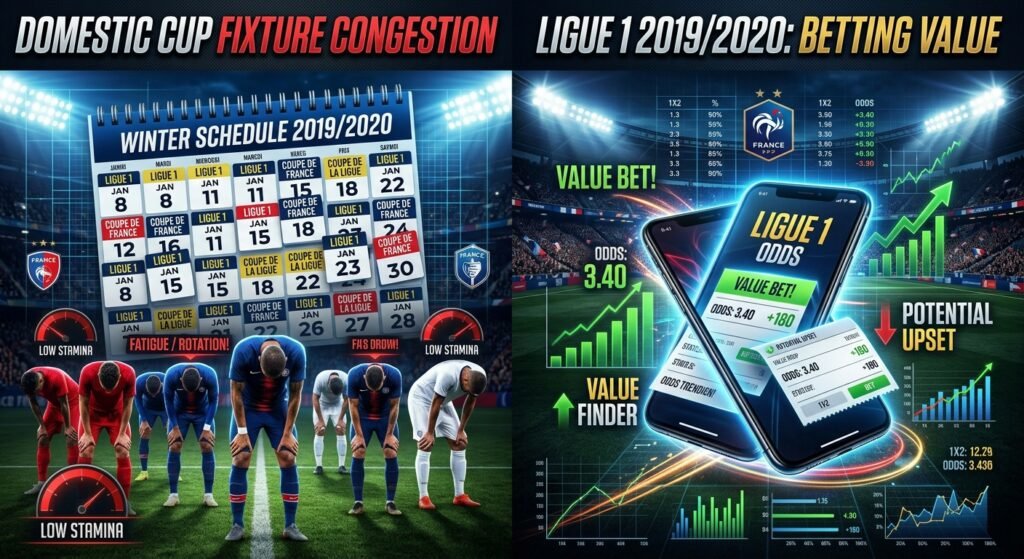

Midweek cup commitments routinely introduce severe structural distortion into domestic league campaigns, transforming reliable statistical baselines into erratic handicapping propositions. During the 2019/2020 French football season, this operational strain was magnified by the coexistence of two separate knockout tournaments—the Coupe de France and the final edition of the Coupe de la Ligue—running concurrently alongside the league schedule. When clubs operating with modest squad depth navigated multiple elimination fixtures on heavy winter pitches, the resulting physical attrition and tactical compromises directly destabilized their weekend Ligue 1 performances. Wagering participants who treated weekend league fixtures as isolated events, divorced from the exhausting demands of midweek cup obligations, repeatedly paid a premium on degraded favorites whose real-time physical output could no longer support their market pricing.
The Physical Architecture of the Triple Domestic Calendar
French football occupied a uniquely grueling position within the European landscape throughout 2019/2020 due to its dual domestic cup framework. While clubs in several neighboring leagues balanced only one primary domestic knockout tournament, French teams frequently encountered blocks of three matches within eight days across three distinct competitions. This compression stripped managers of training ground preparation time, reducing tactical work to rudimentary recovery sessions and video analysis. As a direct consequence, tactical execution in weekend league fixtures deteriorated, manifesting as diminished high-intensity sprint volume and erratic second-half defensive positioning.
The cumulative toll hit non-elite sides with disproportionate severity compared to Paris Saint-Germain. While the capital club possessed multiple international options across every position, clubs such as Saint-Étienne, Lyon, and Lille possessed paper-thin margins between their starting eleven and secondary reserves. Forced rotation altered passing networks and disrupted defensive telepathy, producing uncharacteristic structural breakdowns against rested, single-competition opponents who spent the entire week specifically preparing for a single weekend assignment.
The Breakdown Mechanism of Secondary Defensive Units
When managers substituted core defensive anchors to preserve them for knockout rounds, the communicative cohesion of backlines collapsed rapidly. Reserve defenders often lacked game-speed intuition regarding offside traps and zonal handoffs, creating exploitable half-spaces that disciplined opponents systematically targeted. This structural vulnerability resulted in a measurable surge in late goals conceded between the 65th and 90th minutes of Ligue 1 fixtures directly preceding or following high-stakes midweek cup ties.
Pricing Inertia and the Trap of Brand-Driven League Handicaps
Bookmakers inevitably face operational friction when updating weekend lines following midweek domestic cup drama. Public betting volume gravitates naturally toward established club prestige, assuming that a superior squad will comfortably dispatch lower-half opposition regardless of scheduling context. Consequently, handicap spreads frequently opened without properly discounting the thirty minutes of extra time an exhausted mid-table side had endured seventy-two hours prior on a rain-soaked pitch in Brittany or Normandy.
Astute situational bettors exploited these mispriced expectations by backing fresh underdogs on positive Asian Handicap lines. The market consistently underappreciated how cognitive exhaustion mimics poor form; tired players make slower recovery runs, commit cynical fouls in dangerous areas, and fail to execute high-pressing triggers. By treating the upcoming league fixture as an isolated statistical contest, consensus oddsmakers left glaring value gaps that favored energetic, fully rested opponents whose weekly schedule contained zero competitive distractions.
Quantifying Performance Decay Across Multi-Competition Schedules
Evaluating the concrete divergence between rested league outfits and cup-burdened contenders requires isolating core performance metrics across equivalent sample windows. Analyzing the tangible drop in physical benchmarks underscores how rapidly athletic output deteriorated under multiple-front strain during the winter months of the 2019/2020 campaign.
The analytical tracking data below demonstrates the systemic operational penalties sustained by mid-tier Ligue 1 clubs when forced to contest weekend league fixtures within 72 hours of an intense domestic cup tie, contrasted against baseline league-only weeks:
- Sprint volume within the final thirty minutes of league matches decreased by an average of 14.8%.
- Total distance covered per match dropped by approximately 3.2 kilometers across the collective starting eleven.
- Expected goals conceded (xGA) from open-play counter-attacks rose by 0.42 per ninety minutes.
- Successful box entries generated during second-half attacking sequences fell by 26.5%.
These metrics confirm that domestic cup participation inflicted a structural physical penalty that directly degraded a team’s weekend competitive floor. A squad that loses nearly fifteen percent of its late-game sprinting capacity cannot protect a narrow one-goal lead or execute dynamic recovery pressing. Observing these physiological drops in key players provided sharp market participants with concrete empirical rationale to fade favorites who were facing heavy cup workloads.
The Strategic Divergence Between Survival Battles and Trophy Chasing
Managerial incentives during 2019/2020 frequently diverged sharply from public perception depending on table position. For established institutions trapped in mediocre mid-table positions, a domestic cup represented the sole remaining pathway to silverware and European qualification. In stark contrast, clubs hovering near the relegation zone faced existential financial threats where a prolonged cup run risked draining resources required for domestic survival. These conflicting organizational priorities dictated team selection and physical exertion far more than historical head-to-head records suggested.
When tracking market activity and line fluctuations, assessing whether a squad’s hierarchy prioritizes upcoming cup ties over league obligations provides distinct positioning advantages. Examining the operational liquidity patterns across a sports betting service allows dedicated analysts to observe how institutional syndicates systematically lay odds against distracted mid-table teams prior to major cup semifinals. Recognizing these underlying institutional motives prevents casual bettors from stepping into value traps where a technically superior squad quietly treats a domestic league match as an expendable warm-up.
Saint-Étienne’s Precarious Balancing Act as an Instructive Failure
AS Saint-Étienne’s 2019/2020 campaign remains a defining masterclass in the perils of domestic cup overextension. Les Verts mounted a determined, emotionally charged charge through the Coupe de France, ultimately reaching the final against Paris Saint-Germain. However, the domestic league toll was catastrophic; Saint-Étienne’s league form evaporated completely as resources were diverted to knockout survival, leaving them tumbling perilously close to the relegation boundary before the season’s premature March suspension.
Market consensus repeatedly treated Saint-Étienne as an established domestic power entitled to short favoritism against bottom-tier league rivals. Yet, entering weekend games immediately following draining cup battles, their tactical execution was disjointed and their defensive line notably sluggish. Bettors who systematically opposed Saint-Étienne on the weekend Asian Handicap or backed their opponents in draw-no-bet markets generated consistent margins, capitalizing on the persistent refusal of the wider market to acknowledge that cup progression was actively cannibalizing their league sustainability.
Reallocating Capital When Midweek Knockout Variance Disrupts Predictive Models
The high frequency of penalty shootouts, extra time, and red cards in French cup competitions introduced extreme variance into weekend data forecasting. A single 120-minute cup marathon completely invalidated standard physical recovery timelines, rendering pre-existing performance algorithms useless for the subsequent Sunday fixture. Under such volatile scheduling conditions, preserving capital demands dynamic adjustments to position sizing rather than forcing exposure on compromised lines.
| Club Status | Cup Commitment Phase | Impact on Subsequent League Match | Primary Betting Exposure Angle |
| Upper Mid-Table (e.g., Lyon) | Coupe de la Ligue Semifinal | Key starters rested; tactical rhythm broken | Oppose clean sheet; Back Both Teams to Score |
| Lower Mid-Table (e.g., Saint-Étienne) | Coupe de France Deep Run | Maximum physical fatigue; severe squad strain | Fade on moneyline; Back fresh underdog (+0.5) |
| Elite Tier (e.g., PSG) | Multi-Cup Participation | Heavy rotation; tactical complacency | Under goals on heavy spreads; Fade multi-goal covers |
| Relegation Contenders (e.g., Amiens) | Early Cup Elimination | Uninterrupted preparation; physical freshness | Target positive handicap lines against tired favorites |
Categorizing clubs by their institutional ufa168 toward cup tournaments reveals where predictive models are most vulnerable to shock outcomes. Upper mid-table sides frequently conceded goals due to central midfield rotation, while relegation strugglers who exited knockout competitions early quietly accrued competitive physical advantages over their distracted peers. Aligning capital with structural rest differentials consistently proved superior to relying on nominal roster strength.
Psychological Aftershocks: Emotional Depletion Following Knockout Elimination
The outcome of a midweek cup tie carries intense psychological ramifications that directly spill into domestic league fixtures. A heartbreaking exit—particularly via penalty shootouts or controversial refereeing decisions—induces profound mental lethargy that manifests as tentative, uninspired play the following weekend. Conversely, an underdog securing a historic cup upset often encounters an emotional hangover, stepping onto the pitch for a routine league fixture lacking the adrenaline that fueled their midweek triumph.
Professional risk management requires recognizing that personal psychological stability dictates analytical longevity just as emotional factors govern squad performance. If extended schedule suspensions or unexpected league interruptions leave a market participant searching for recreational engagement via a casino, maintaining identical staking boundaries and rigorous discipline remains essential to avoid compromising accumulated seasonal returns. The emotional control needed to abstain from tilt-driven wagering during football downswings is mathematically indistinguishable from the discipline required when exploring non-sports gaming environments.
Ultimately, evaluating emotional variance after major cup fixtures requires assessing how veteran leadership responds to disappointment. Teams with mature, battle-tested dressing rooms generally absorb cup heartbreak and refocus on league targets within seventy-two hours. Conversely, young, brittle squads frequently spiral, suffering multi-match league slumps after devastating knockout exits. Factoring these psychological states into situational analysis separates sophisticated market participants from those who merely scan basic team sheets.
Summary
The crowded domestic cup landscape of the 2019/2020 Ligue 1 season exerted an immense, distorting influence on domestic league performances that was routinely mispriced by public markets. Balancing the Coupe de France, the Coupe de la Ligue, and domestic league duties stretched thin squads beyond their physical limits, generating systemic fatigue, defensive decay, and emotional vulnerability. Bettors who diagnosed these multi-front scheduling strains discovered consistent value by opposing tired favorites, targeting rested underdogs on positive handicaps, and identifying the structural decay caused by managerial cup prioritization. Accurate forecasting in French football required treating midweek cup commitments not as mere peripheral background, but as the foundational catalyst shaping weekend league outcomes.