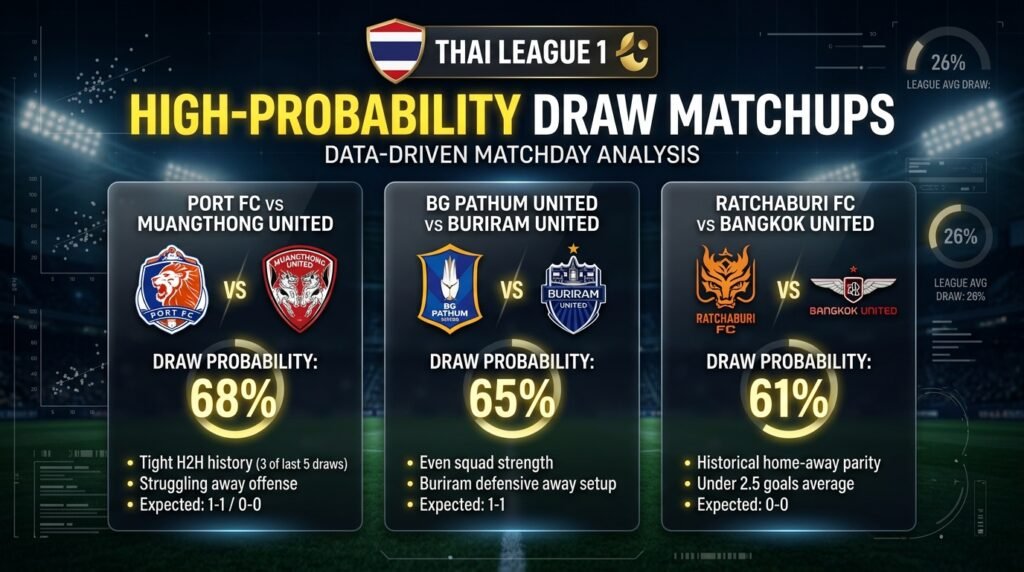

Predicting a draw in domestic league football demands a fundamental departure from conventional winner-oriented modeling, shifting analytical attention away from attacking superiority and toward structural stalemate conditions. In the Thai League context, parity on the scoreboard rarely emerges by accidental alignment; it develops from specific tactical interactions, asymmetric risk profiles between mid-table sides, and mutual game-management incentives. When two teams prioritize defensive preservation over transitional expansion, the mathematical probability of a level finish increases significantly beyond what standard three-way market lines typically imply.
Tactical Symmetry and Mutual Risk Aversion
A high probability of a draw develops primarily when two competing sides deploy mirror tactical systems that neutralize each other in central progression areas. When both squads line up in rigid mid-block formations—typically compact variations of 4-2-3-1 or 5-3-2—neither midfield unit possesses the numerical superiority required to carve open spaces between defensive lines. This tactical gridlock channels possession out wide, where overlapping fullbacks are routinely closed down by disciplined wing-backs, forcing harmless aerial deliveries into packed penalty areas.
Risk tolerance diminishes drastically in mid-season encounters between clubs separated by minimal points in the league table. Managers recognize that conceding a solitary point to a direct positional rival yields far less damage than dropping all three points on a failed counter-press. Consequently, both technical areas instruct central midfielders to hold their rest-defense positions rather than make late runs into the box, suppressing open-play expected goals (xG) and cementing parity through collective caution.
The Relegation Survival Points Threshold Dynamic
Late-season league positioning alters the objective utility of an individual match point, creating fixtures where a draw represents the optimal mutual resolution. Relegation-threatened sides calculating their mathematical survival path often operate under a strict “point-a-game” threshold, leading to overtly defensive game plans when facing peers in the bottom half of the standings.
Analyzing how clubs approach these high-stakes fixtures reveals clear patterns across specific league segments, demonstrating how strategic conservatism dictates match outcomes. To accurately project how defensive metrics correlate with split-point tendencies, one must observe how goals conceded, average possession share, and shooting volume interact across contrasting competitive brackets.
| Table Segment Profile | Primary Tactical Objective | Average Shots on Target Conceded | Historical Draw Propensity |
| Mid-Table vs Mid-Table | Point preservation; low-risk territorial containment | 2.5 – 3.5 per match | High; mutual satisfaction with baseline point |
| Relegation Contender vs Relegation Contender | Direct rival denial; extreme deep block | 1.8 – 2.8 per match | Very High; fear of defeat supersedes chase for win |
| Title Contender vs Low-Block Host | Breakdown challenge vs counter containment | 4.0 – 5.5 per match | Moderate; heavily contingent on early breakthrough |
These systemic behaviors demonstrate that draw probabilities are not evenly dispersed throughout the season; they concentrate heavily within specific operational bands where both participants view an equal outcome as a stabilizing strategic gain.
Climate-Driven Tempo Suppression in Second Halves
Sustained equatorial heat and extreme humidity exert a profound, decelerating influence on late-stage match intensity in Thailand. Teams that exhaust their anaerobic stamina pressing aggressively in the opening forty-five minutes inevitably encounter a physical wall midway through the second period, prompting a deliberate compression of tempo.
Transition Extinction Under Physical Depletion
- Recovery runs slow down across the forward line, abandoning structured pressing traps in favor of a static zonal shield.
- Fullbacks cease overlapping maneuvers past midfield to prevent exposing defensive space to opposition wingers.
- Set-piece routines default to short, defensive recycling rather than high-commitment box overload runs.
This physical deceleration eliminates the chaotic transitional moments that typically produce late winning goals, settling the game into a rhythm of risk-free lateral circulation between central defenders.
Defensive Over-Performance Against Mismatched Attacks
A frequent blind spot in pre-match analysis involves overestimating a favored team’s capacity to penetrate an organized low defensive block away from home. When an elite side encounters a resolute home defense that intentionally surrenders seventy percent of possession, the attacking favorite often falls into low-efficiency possession traps, cycling the ball horizontally without penetrating the eighteen-yard box.
Under conditions where standard pre-match metrics suggest a lopsided victory for a traveling favorite, opening an established sports betting service like สูตรบาคาร่า ufa168 enables detailed monitoring of how real-time odds price the persistence of a nil-nil deadlock as match time elapses. Recognizing that an underdog’s defensive cohesion is effectively choking central passing lanes allows disciplined analysts to identify value on level finishes before late odds movements close the gap.
Game-State Management After Mid-Match Parity
When two evenly matched teams find themselves level at 1-1 entering the final quarter of the match, the psychological dynamics shift into extreme loss aversion. Substitutions during this interval almost universally favor defensive reinforcement—replacing spent wingers with defensive midfielders or moving to a five-man backline—effectively signaling that neither bench is willing to destabilize its defensive baseline to hunt a decisive winner.
Unlike games where a trailing team is forced to commit excess bodies forward, creating spaces for counter-attacks, a tied state past the seventieth minute incentivizes both sides to run down the clock. Throw-ins, goal kicks, and minor fouls are exploited to absorb regulation time, significantly suppressing the mathematical probability of a late decisive goal.
The Structural Divergence of Static Probabilities
Unlike dynamic sports where game states evolve through continuous physiological and tactical adjustments, comparing these patterns to completely isolated digital environments reveals crucial analytical differences.
Looking at the operational framework of a casino online website illustrates this divide; in that setting, mathematical distributions remain strictly static and entirely uninfluenced by shifting human emotion, fatigue, or operational strategy. On a football pitch, however, the likelihood of a draw is an evolving metric, fluctuating dynamically in response to physical fatigue, managerial pragmatism, and situational psychology over ninety minutes.
Analytical Traps Where Stalemate Projections Disintegrate
Targeting draw outcomes carries structural vulnerabilities that can rapidly invalidate even the most rigorous pre-match evaluation. The primary vulnerability is an uncharacteristically early goal resulting from an isolated goalkeeping error or a contentious penalty decision inside the opening ten minutes.
Once an early goal breaches a low defensive block, the trailing team’s game plan is immediately dismantled, forcing an aggressive tactical expansion that shatters the projected stalemate. Similarly, an early referee dismissal completely shifts territorial balance, exposing the numerically disadvantaged squad to severe physical overloads that rarely conclude with split points.
Summary
Identifying high-probability draw matchups in the Thai League requires isolating fixtures characterized by tactical symmetry, mutual points preservation incentives, and environmental factors that naturally depress second-half match tempo. Stalemate outcomes are actively engineered by managers through conservative substitutions, defensive rest structures, and risk-averse game management. By evaluating how these structural conditions intersect while accounting for the destabilizing impacts of early errors or disciplinary interventions, one can effectively separate genuine structural deadlock candidates from conventional competitive fixtures.